



Caught for Thirty-Three Dollars

The number is almost too small to believe: thirty-three dollars. Not thirty-three thousand. Thirty-three. That is the entire sum that ended the career of Neil Ashworth, a veteran teacher at a school board in Nebraska, a man who had stood in front of children since the mid-2000s. He was not a stranger who slipped in after dark. He was a familiar face, trusted with keys, trusted with kids, trusted to be the adult in the room. And yet a silent camera mounted in the school office would capture him doing something that made no sense for a man with so much to lose. He used a key. He opened a drawer that was supposed to be locked. He took the cash. And he came back to do it again. Why would anyone risk everything for the price of a cheap lunch?
The Man Everyone Trusted

To understand the shock, you have to understand the man. Neil Ashworth had been certified to teach since 2004, two solid decades of lesson plans, parent meetings, report cards and quiet routine. Colleagues knew him as steady and unremarkable in the best way — the kind of teacher who showed up, did the work, and never made headlines. He had earned the small privileges that come with seniority: access to the office, familiarity with where things were kept, the easy comfort of a man who belonged. Nobody watches a person like that. Nobody suspects him. That trust was precisely what made the office a place he could move through without a second glance. But somewhere behind the ordinary face, something had quietly come loose. And the first person to sense that something was wrong would not be a colleague at all — it would be a machine.
Money That Kept Vanishing
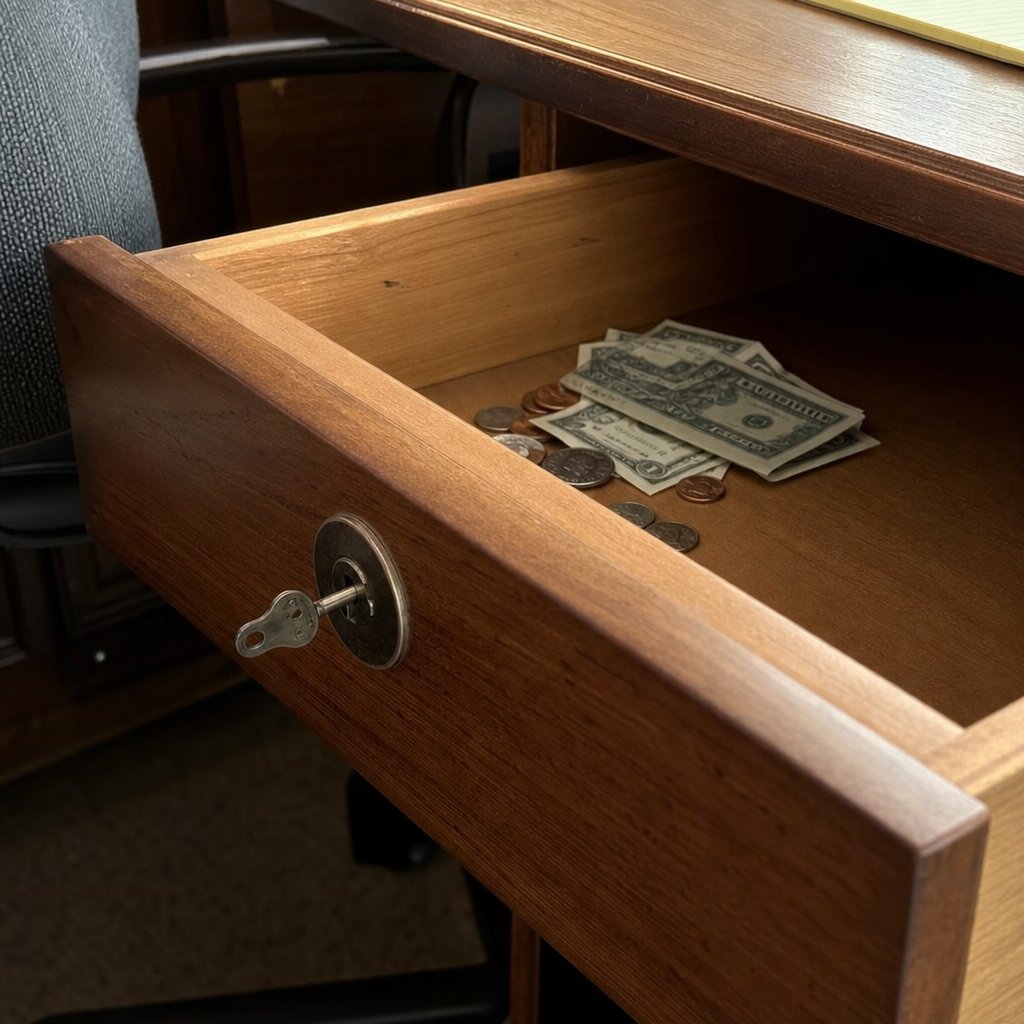
It started, as these things often do, with a feeling that the numbers were off. Small amounts of cash kept going missing from a drawer in the school office — never enough to set off alarms, never enough to be certain you hadn't simply miscounted. A few dollars here. A few there. The kind of loss easy to explain away as a mistake, a memory lapse, a bill spent and forgotten. But the shortfall kept happening, quietly and steadily, and eventually somebody stopped explaining it away and started asking a harder question: what if this isn't an accident? What if someone is taking it? The drawer was kept locked. Only certain people had a way in. And so a decision was made that would turn a vague suspicion into something undeniable. They would let the room watch itself. Somewhere above the desk, a small lens was about to start recording.
A Camera Starts Recording

The plan was simple and patient. A surveillance camera was positioned to keep a steady eye on the office and, in particular, on the drawer where the money lived. Then everyone waited. There is something chilling about a trap built entirely out of patience — no confrontation, no accusation, just a quiet machine and the certainty that whoever was doing this would do it again. Days passed. The camera blinked in its corner, ignored, invisible, exactly the way good surveillance is meant to be. And then it happened. A familiar figure entered the office, alone. He moved with the unhurried ease of a man who had every right to be there, because he did. He approached the desk. He reached for the drawer. And the lens recorded a small, ordinary key sliding into a lock it was never supposed to open.
Five Days on Tape

It was not a single bad moment. That is the detail that lingers. The video surveillance did not catch one impulsive lapse — it caught a pattern. Over the course of five separate days, the camera recorded Neil Ashworth returning to that same drawer, using the same key, removing cash a little at a time. Five days. Five chances to stop, to think, to feel the weight of what he was doing and walk away. Each visit looked almost casual on the tape, the practiced motions of a man who had done it before and expected to do it again. And the grand total he collected across all five days, every furtive trip combined, came to just thirty-three dollars. Investigators now had what they needed: not rumor, not a hunch, but a clear, repeated, recorded record of a trusted teacher quietly stealing. The reckoning was no longer a question of if, but when.
Confronted With the Evidence

There is no good way to be shown a video of yourself stealing. When the footage was laid out, there was nothing left to argue, no innocent explanation that could survive what the camera had captured across five separate days. The evidence was not circumstantial; it was him, plainly, doing the thing again and again. For a man who had spent twenty years building a reputation as the dependable one, the steady one, the moment must have been a kind of free fall — watching his own hands betray him on a screen. The board moved quickly. There would be no quiet warning, no second chance buried in a personnel file. The consequences were already in motion, and they were severe enough that Neil Ashworth would make a decision that very same day — a decision that would close the door on his career before anyone else could close it for him.
Suspended and Gone the Same Day

It all collapsed in a single day. Neil Ashworth was suspended without pay and told, plainly, that there would be a recommendation to end his employment. The machinery to dismiss him was already grinding into motion. He did not wait for it. On that very same day — the same hours in which he learned his job was effectively over — he resigned from the board. Twenty years of work, ended not with a retirement card but with a quiet exit under a cloud, all over thirty-three dollars in stolen cash. And here is a detail that makes the whole story stranger still: the police were never called. No officer ever knocked on his door. No charges were ever laid. A man caught red-handed on camera, repeatedly, simply walked away from the classroom forever. But walking away from his employer was not the same as walking away from what he had done.
A Letter and a Cheque

Months passed in silence. And then, when he could have simply disappeared, Neil Ashworth did something unexpected. He sent the board a letter — and with it, a cheque for one hundred dollars. He had taken thirty-three. He paid back a hundred. In his own words, he said he regretted his conduct, that it was out of character, that it had been a mistake. He offered the one explanation that hovers over this entire story: he had been experiencing financial difficulties at the time. It is a small, human gesture, the kind of thing a person does when guilt has had months to settle in. But it also deepens the mystery rather than solving it. A man desperate enough to risk his career for thirty-three dollars later finds a hundred to give back. What kind of trouble does that, and what kind of remorse follows it?
Guilty of Professional Misconduct

Eventually the matter reached a teachers' disciplinary board, and Neil Ashworth did not fight it. Based on an agreed resolution and a guilty plea, the board found him guilty of professional misconduct. He was called to appear in person for a formal reprimand — made to sit and answer for thirty-three dollars taken from a locked drawer — and ordered to complete a course in ethical behaviour. But the board also did something telling: it listened to the rest of the story. It accepted that this was an isolated occurrence, a single dark chapter in an otherwise clean record. It accepted that he had been struggling financially when it happened. And it accepted that he had never done anything like this before, and had not done it since. The punishment was real, but measured — the response not of people seeking to destroy a man, but of people genuinely puzzled by him.
Why Over Thirty-Three Dollars?

And so we are left exactly where we started, staring at a number that refuses to make sense. Thirty-three dollars. A career that took two decades to build, traded away on camera, over five separate days, for less than the cost of a tank of gas. He was certified, experienced, trusted — and he threw it all into a locked drawer for almost nothing. The financial difficulties he described might explain the impulse, but they cannot explain the math, because no amount of hardship makes thirty-three dollars worth a lifetime's reputation. Maybe it was never really about the money at all. Maybe it was something quieter and sadder — a man unraveling, reaching for a small forbidden thing because the larger things in his life had already slipped beyond his grasp. We will likely never know what was going through his mind in that office. So what do you think he was really reaching for in that drawer?
A dramatized retelling based on real teacher-discipline records. Names, locations, and identifying details have been changed. Any resemblance to actual persons is coincidental.